The Zodiac That Changed When It Crossed the Sea – Why Japan’s zodiac animals are not quite the same as China’s
Japanese zodiac animals are not quite the same as those in China, and the differences tell a much deeper cultural story.
Japan loves cats. Which makes one thing rather strange.
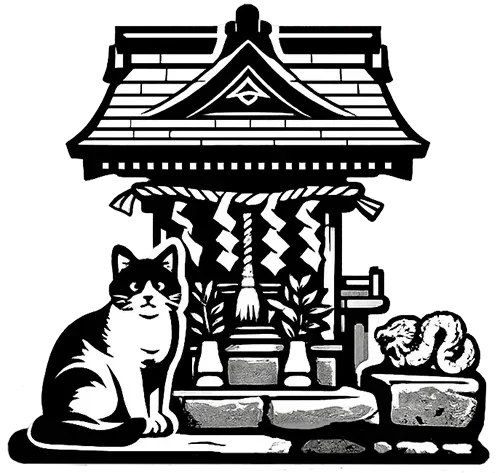
Cat cafés line the backstreets of Tokyo. Lucky cat statues beckon from shop entrances. Neighbourhoods quietly look after the cats that live among them — community cats, identifiable by the small V-shaped notch in one ear, a sign they are neutered and cared for. On social media, Japanese cats have fan bases that rival those of celebrities.
And yet, when the zodiac animal changes each New Year, you will often hear the same question murmured somewhere:
“Why isn’t the cat one of the zodiac animals?”
And then, almost always: “It was the rat, wasn’t it?”
Most people know a story involving a race. Depending on where you heard it, the animals may have gathered at the invitation of the Jade Emperor — or they may have been hurrying to pay their respects to the dying Buddha. In either version, the rat arrived first. And in either version, the cat was tricked into missing the whole thing. By the rat. On purpose.
Either way, the story is folklore rather than the historical origin of the zodiac.
The twelve animals — and what Japan has quietly done with them — are a stranger and more interesting tale than the race suggests.
THE REAL ORIGIN
So if the race is folklore, what actually is the zodiac?
The answer is less dramatic, but in its own way, more interesting.
Long before any animals were involved, ancient China had a system of twelve units used to track time and direction. They were written with characters — 子, 丑, 寅, 卯 — and used by astronomers, calendar makers, and court officials. Abstract. Precise. Entirely animalless.
The animals came later — much later. At some point — historians place it roughly in the first millennium BCE, though the exact origins are still debated — each of the twelve units became associated with a creature. Nobody knows exactly why those particular twelve. Nobody knows exactly why in that order. What we do know is that by the time the system had spread across East Asia, the animals had become inseparable from it.
This is the thing about the zodiac that tends to get lost in the race story: the characters came first. The animals are, in a sense, a visual translation of an abstract system.
The rat, for instance, was never originally a character in a moral story. It was simply the first position in a sequence — 子, the beginning of the cycle. But once stories were attached to it, the rat began to carry meanings it did not choose.
And translations, as Japan would eventually demonstrate, do not always stay faithful to the original.
WHERE THE TRANSLATION DIVERGED
The zodiac reached Japan sometime around the sixth century, carried along the same routes that brought Buddhism, writing, and the Chinese calendar system to the archipelago. Japan received all of it — and then, quietly, began to make adjustments.
Some of those adjustments are easy to miss. Others stop you mid-sentence.
🐗 The pig that became a boar
In the Chinese zodiac, the final animal is a pig. Domestic. Round. Associated with prosperity and good-natured ease.
In Japan, it is a boar.
The reason seems to be one of simple geography. When the zodiac arrived in Japan, wild boars were a familiar and formidable presence — creatures of the mountain, associated with ferocity and unstoppable forward momentum. The domesticated pig, by contrast, was not yet part of everyday life in the same way. So Japan kept the slot, and changed the animal.
The Japanese word for this quality — 猪突猛進, chototsumoshin — describes someone who charges ahead without looking left or right. It is not always a compliment. But it is distinctly a boar.
🐇 The rabbit and the moon
Both China and Japan place the rabbit in the zodiac. On the surface, nothing has changed.
But the way Japan views this rabbit is unique.
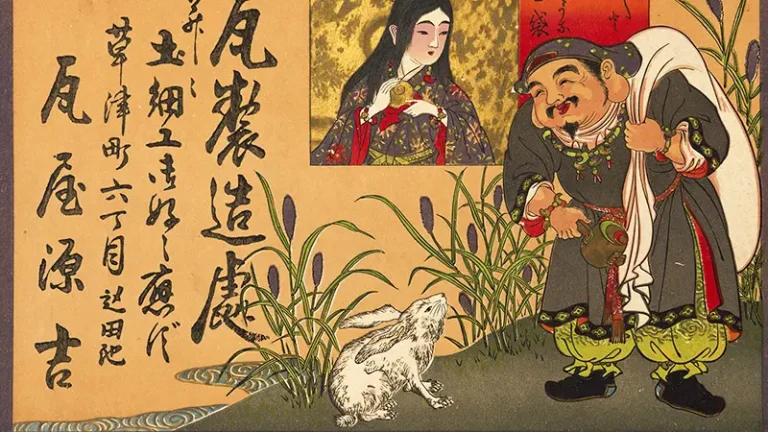
In Japan, the rabbit is inseparable from the moon. On clear nights, where some cultures see a face or a bear or a pair of hands, Japanese tradition sees a rabbit — pounding rice cakes with a small wooden mallet. The image appears in poetry, in picture books, in autumn festival decorations. It is simply there, the way certain things are simply there when you grow up with them.
The rabbit did not change its place in the zodiac. What changed was everything that gathered around it. In Japan, it became not just the rabbit of the moon, but a creature of myth, shrines, paintings, and stories that continued to grow long after the zodiac itself arrived.
🐉 The dragon’s temperature
To understand the dragon in Japan, we have to forget the fire-breathing monsters of Western fantasy.
When you hear the word dragon, what do you see? If you grew up in the West, probably fire. Scales. Something that needs to be slain, or at least avoided.
The dragon of East Asian tradition is a different creature entirely. It lives in water. It brings rain. It is a deity of rivers and seas, a bringer of blessings rather than destruction. In Japan, the dragon — ryū — guards temples, coils around shrine pillars, and watches over wells.
Same word. Completely different animal.
When the dragon reached Japan, it entered a culture that already revered rivers, mountains, and serpentine deities. It did not replace those traditions. It found a home among them.
DAILY LIFE, AND A QUIET DOOR
Sheep were not native to Japan. For centuries, Japanese people only knew them through Chinese drawings, which led to some Edo-period artists hilariously drawing sheep that looked suspiciously like goats. Yet, despite having never seen a real one, Japan kept the sheep in the calendar anyway.
But the zodiac itself rooted deeply.
The twelve animals are not confined to the year of your birth. They also mark the hours of the day, dividing time into the Hour of the Rat, the Hour of the Ox, and so on. They mark the compass as well: north belongs to the Rat, south to the Horse, east to the Rabbit. In Japan, these associations shaped everything from castle-town planning to the timing of temple bells and daily life.
At New Year, the animal of the year appears everywhere — in shop windows, on greeting cards, in decorations that quietly reshape the streets for a season. Children born that year will carry it with them for the rest of their lives — a fragment of the calendar written into identity itself.
It is a quiet kind of presence, rather than something people go out to meet. It settles into daily life instead of being formally received.
This raises, perhaps, a question.
If the animal of your birth year is woven so deeply into Japanese culture — into time, direction, shrine traditions, and celebration — it is not surprising that it is also connected to something else. Something older, and in some ways stranger.
In Japan, each zodiac animal is also associated with a guardian Buddhist deity. For example, those born in the Year of the Rat are watched over by Senju Kannon (the Thousand-Armed Goddess of Mercy). It’s another layer, quieter still, waiting beneath the calendar—a topic I look forward to exploring in a future post.