The Rabbit Before the Moon
Japan’s oldest rabbit story, and what it left behind
There is a book called the Kojiki(古事記) — compiled over thirteen hundred years ago, one of the oldest books in existence. It is a remarkable read: part history, part mythology, a record of the age when gods walked the earth and Japan itself was still taking shape.
My favourite story in it — because of course I have a favourite, and of course it involves a rabbit — is the tale of the White Rabbit of Inaba. Fair warning to fellow rabbit enthusiasts: it does not start well for our protagonist. In fact, this particular rabbit has no fur.
It has just been stripped of it — deceived, exposed, left on a beach in agony. This is the rabbit before the moon, before the symbolism, before the shrines. Just a small creature, a long way from home, having made a rather serious mistake.
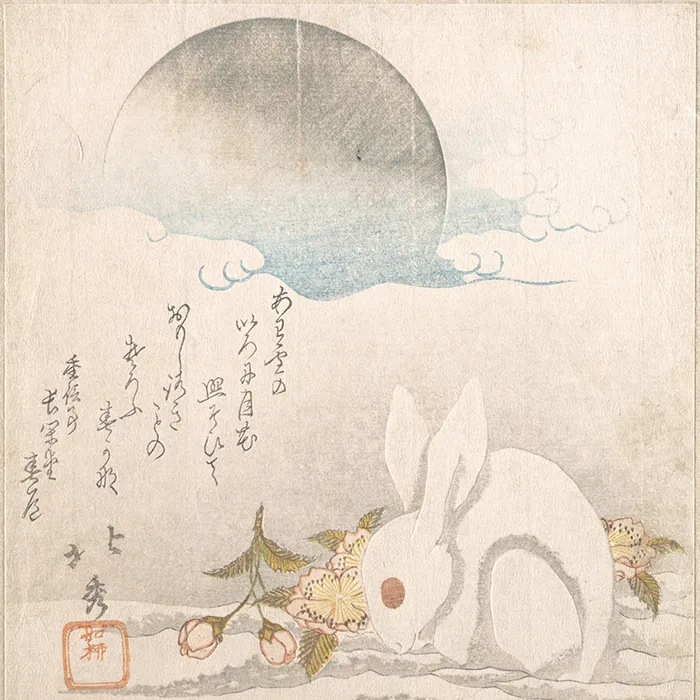
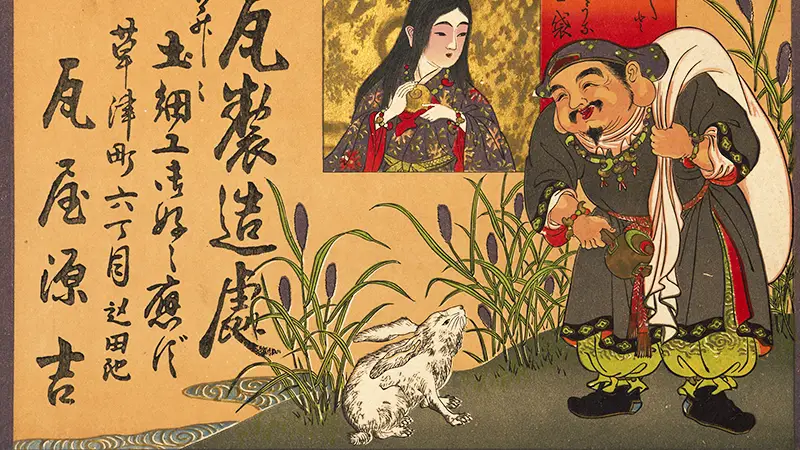
The Metropolitan Museum of Art, Open Access.
THE WHITE RABBIT OF INABA
The rabbit lived on the island of Oki, off the coast of what is now Shimane Prefecture. It wanted to reach Inaba — the province on the other side of the sea, in what is now Tottori. There was no bridge. There was no boat. There was only the ocean, and the sharks that moved through it.
So the rabbit devised a plan. It approached the sharks — wani in the old language, a creature of the sea, often interpreted as a shark-like or crocodile-like being, a creature of the sea that commanded respect — and proposed a contest. Surely there were more sharks in the ocean than rabbits on Oki? Let them line up from the island to the shore, so they could be counted properly. The sharks, for reasons best known to themselves, agreed.
The rabbit ran across their backs, counting as it went — one, two, three — all the way to the final shark, just short of the shore. And there it made its mistake. It laughed. It could not help itself. It told the last shark exactly what it had done: no contest, no counting, just a trick to cross the sea.
The shark was not amused. It seized the rabbit and stripped it of its fur, leaving it raw and burning on the beach, with nothing to cover it and no one to help.
The story might have ended there — a cautionary tale about the cost of cleverness, neatly concluded. But then the gods arrived.
A long procession of them: eighty deities, all brothers, each carrying his own luggage and ambitions, passing along the shore on their way to court the daughter of a great god. They saw the rabbit and stopped. And then, with the casual confidence of people who have never had to think very hard about anything, they told it to go and bathe in the salt water of the sea.
The rabbit did. The salt dried on its wounded skin. The pain became unbearable. It lay there, worse than before, abandoned in the place where the gods had left it.
THE GOD WHO STOPPED
The last of the procession was travelling alone, carrying all of his brothers’ luggage — because that was the role they had assigned him. The youngest. The least regarded. The one at the back. His name was Ōkuninushi no Mikoto, and he would one day become one of the most important deities in all of Japan. But on this particular morning, he was just the god carrying everyone else’s bags.
He found the rabbit on the beach. He stopped. He asked what had happened. And then, unlike his brothers, he said something useful.
Go to the mouth of the river, he said. Wash yourself in fresh water. Then gather the bulrushes that grow along the bank — GAMA — and roll in their pollen. Let it settle over you. Rest.
The rabbit did. The fresh water eased the wound. The pollen, soft and fine, settled over its skin like a covering. Slowly, as the old texts tell it, the fur began to return.
This is the moment that has stayed in Japanese memory for over a thousand years. Not the trick, not the punishment — the healing. A god who was nobody, carrying luggage, stopping for an animal that had been left for dead.
The rabbit recovered. And in gratitude — or perhaps because it had seen something in this unhurried god that the others lacked — it made a prophecy. The great princess they were all travelling to court would not choose any of the eighty brothers. She would choose the one who had stopped.
She did. The brothers who had walked past without a second glance arrived at the princess’s court and were turned away. The luggage-carrier married her instead.
Ōkuninushi went on to become the god of nation-building, of medicine, of the unseen forces that draw people together. The Japanese word for that drawing-together — en, the ties of fate and relationship — is his domain. Izumo Taisha, one of the oldest and most sacred shrines in Japan, is his home. And it began, in a sense, with a rabbit on a beach.
THE SHRINE ON THE BEACH
On the coast of Tottori Prefecture, not far from where the white rabbit once lay in the sun trying not to die, there is a shrine. Hakuto Jinja — White Rabbit Shrine — is well known among rabbit enthusiasts in Japan, and it is very much on my list of places I intend to visit.
The shrine is dedicated to the rabbit as a guardian of EN — the ties of fate that bring people together. The rabbit that predicted a marriage became, across the centuries, a protector of meetings and connections and the invisible threads between people who were meant to find each other. Couples come here. People seeking connection come here. It is a place that takes the rabbit’s role in the story seriously, and remembers it accordingly.
This is one of the paths by which a rabbit becomes sacred in Japan.
In an earlier essay, The Rabbit That Meant Something Different in Japan, I explored how rabbits became connected with battlefields, the moon, and sacred spaces across Japanese history.
At Okazaki Shrine in Kyoto, the rabbit came from nature — from the wild rabbits that once lived on the land, and from the city’s old compass orientation that placed the rabbit in the east. In Uji, it came from language — from a place name carrying the character for rabbit inside it. At Tsuki Shrine in Saitama, it came from the moon and the old practice of moon-waiting.
At Hakuto Jinja, it came from a story. Not a decorative story — a story in which the rabbit did something that mattered, and was remembered for it. This rabbit is enshrined for the same reason Ōkuninushi is: it was present at the decisive moment, it paid attention, and it responded in the only way that counted.
THEY ALL BECAME ONE
Whenever I find a rabbit at a shrine — and there are rather more rabbit shrines in Japan than most people realise — I find myself doing a kind of delighted mental inventory. Which rabbit is this one? What story does it carry? Is it here because of mythology, or geography, or the moon, or something else entirely? It is, I confess, one of my favourite games.
Is it the rabbit of the Kojiki — the one who crossed the sea on borrowed backs and paid dearly for it, who lay stripped of everything on a beach and was quietly put back together by a god nobody had noticed yet?
Or the rabbit of the moon — the one who gathered wood, built a fire, and stepped into it without hesitation, so that something more important than itself could be fed? The one pressed into the face of the moon by a god who had no other way to express what he felt?
Or the rabbit of the scrolls — wrestling frogs, shooting arrows, living with the cheerful irreverence of a creature that knows it belongs in the story? The rabbit on the warrior’s helmet, whose wave-shaped ear guards whisper of Chikubushima to anyone who knows to listen?
When I first started collecting rabbit things, I never imagined that one animal could carry so many different worlds inside it.
One rabbit gives itself to the fire. Another loses its skin on a beach. One lives on the moon. Another waits quietly beside a shrine.
They are not the same rabbit. And yet, in Japan, they remain indistinguishable.
Somewhere out there, the beach at Hakuto Jinja is waiting. So are a great many other rabbit shrines I have not yet visited. Getting to all of them — that is the dream.