Fushimi Inari: A Walk Through the Sacred Mountain
The headquarters of all Inari shrines in Japan — the sōhonsha, the original source — is Fushimi Inari Taisha in Kyoto, a shrine that has been in continuous existence since 711 CE. That is over 1,300 years. It predates most of what we think of as “historical” in the Western sense.
Many visitors to Fushimi Inari will encounter fox statues throughout the grounds and assume the fox is the deity being worshipped. This is a common misunderstanding. The fox is not a kami. It is a shinshi — a divine messenger, a servant. The principal deity of Fushimi Inari Taisha is Ukanomitama-no-Kami, associated with the harvest, abundance, and commercial success. The fox acts on behalf of the deity. It is not the deity itself.
The Gates
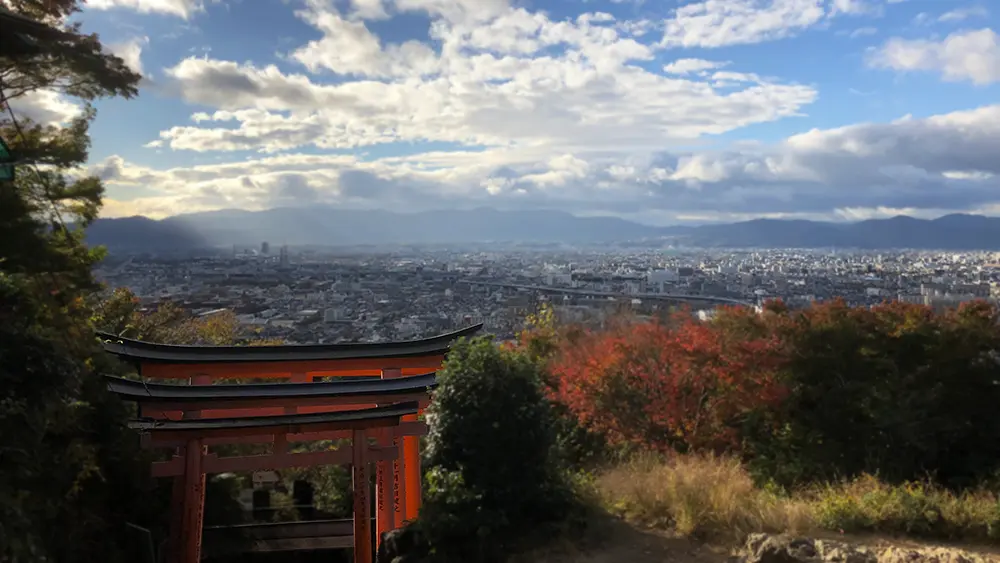
The most immediately striking feature of Fushimi Inari is the senbon torii — the thousand torii gates, tunnelling up the mountain in parallel rows, vermilion red against the dark of the trees.
This is, by most measures, one of the more extraordinary visual experiences available in Japan. The photograph is almost impossible to avoid, and the image has spread globally.
A few things worth knowing before you go.
Fushimi Inari is not a monument. It is not a heritage site managed for tourism. It is an active place of worship where people have come to pray for over thirteen centuries, and where devoted worshippers continue to come today. The gates themselves were donated by individuals and businesses as acts of faith — each one carries the donor’s name on the back pillar, each one is someone’s prayer made physical.
If you visit and wish to photograph the gates, please be aware that other visitors are there to worship. Give way to those who have come to pray. The space is generous enough for both purposes, but one has priority.
Beyond the Gates
Beyond the famous gate tunnels lies the inner sanctuary, okusha. For those who have come primarily to see the gates, this is a natural place to turn back. Many visitors do exactly that, and it is a reasonable choice.
What lies beyond is not simply more hiking. It is a living place of concentrated faith. The atmosphere changes as you climb deeper into the mountain. Time seems to move differently there.
What the Fox Statues Hold
Fox statues throughout the shrine often carry symbolic objects: a jewel, a scroll, or a key. These are not decorative choices but traditional attributes — symbols of the deity’s authority over prosperity, knowledge, and the storing of grain and wealth.
The Mountain
Fushimi Inari Taisha is not only a shrine at the base of a hill. It is a shrine built upon a sacred mountain, and the mountain itself is regarded as a sacred body of the deity.
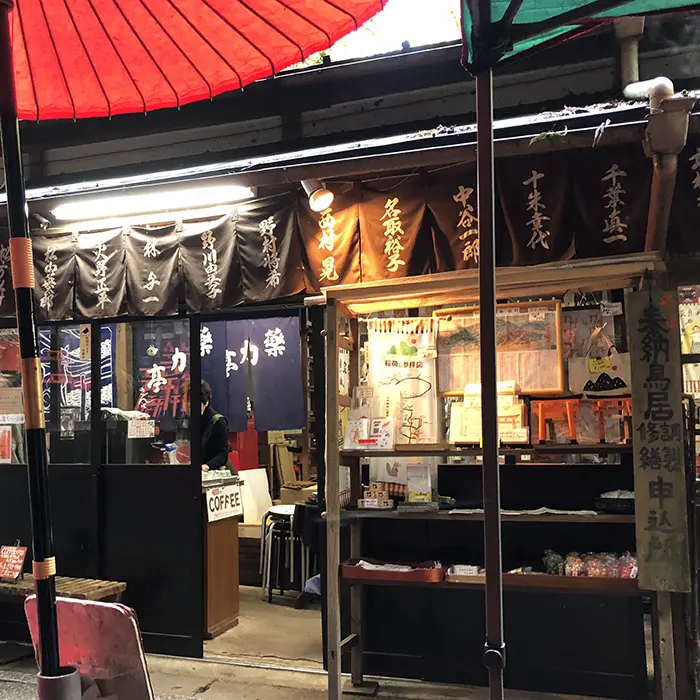
The path continues upward from the inner sanctuary — past smaller shrines at each turning, past stalls selling amulets and tea, past the gradual thinning of the crowds — to the summit of Inari-yama. The round trip takes approximately two hours.
The path is all stairs. In some ways this is harder than climbing an ordinary mountain: there is no variation in terrain, nowhere to settle into a rhythm that isn’t also a climb. The legs notice.
I always climb it when I visit.
What I find harder to explain is the feeling that comes after passing the famous gates and climbing deeper into the mountain. Even after many visits, I still feel a certain tension whenever I begin the climb.
Inari-yama is said to be home to countless fox messengers serving the deity. I do not claim to see them. But I often have the feeling of being quietly observed and assessed. What sort of person are you? Why have you come here? Are you behaving with respect? The mountain has a way of making such questions feel unexpectedly important.
This may be why I carry a plastic bag and pick up litter on the way up. Part of me would like to think I am helping to care for the mountain. Another part suspects I am simply trying to earn a few extra points with the foxes. It is probably not a very sophisticated theological position.
In recent years, more visitors have come, and with them, unfortunately, more litter. Many regular visitors quietly pick up what they find on the path. I have fallen into the same habit.
This is not a hiking trail. It is a sacred mountain.
The Fox Smith: Mitsurugi-sha
Partway up the mountain stands a small shrine, Mitsurugi-sha, associated with one of Japan’s most famous katana.
According to legend, the swordsmith Sanjō Munechika was commissioned by the emperor to forge a great blade but could find no suitable assistant. He prayed at Fushimi Inari, and a mysterious young boy appeared and offered to help. As they worked together, the smith eventually understood that his helper was no ordinary child — but the white fox spirit of Inari in human form. The resulting sword was named Kogitsunemaru — Little Fox — in honour of the spirit who had struck the metal alongside him.
Charms associated with the legend can still be found near the shrine — not at the main amulet counter of Fushimi Inari Taisha, but at a small tea house, which stands close to the shrine and sells the katana-shaped charms.
I once bought one — about 5 centimetres long, shaped like a miniature katana — and tucked it into the inside pocket of my coat.
Several days later, while leaving Japan at the airport, a security officer asked whether I was carrying a katana.
My immediate reaction was bewilderment.
Of course not.
What on earth was the officer talking about?
Then I remembered the charm.
More accurately, I remembered that I had spent the last several days carrying a miniature katana in my coat pocket.
The officer was very kind about it.
Otsuka Faith
Partway up the mountain, you will encounter a different kind of space.
Dotted throughout the upper sections of Inari-yama are otsuka — personal stone monuments and small shrines erected by individual devotees over the generations.
Each otsuka carries a name, given by the person who commissioned it, under which they worship Inari as their own private protective deity.
The effect is extraordinary. The mountain is covered in them — some clearly maintained and regularly visited, some apparently long abandoned, the names faded.
I tend not to linger in these areas. Walking through them feels, to me, like stepping uninvited into someone’s private room. These are expressions of individual faith, specific and personal. That quality deserves something — not avoidance, but a certain quietness.
If the foxes truly serve the deity, I sometimes wonder what they would find most offensive. Perhaps not human mistakes. Perhaps not forgotten words. But disrespect toward the deity they faithfully serve.
For this reason, some Japanese people are surprisingly cautious around Inari shrines. You will occasionally hear warnings that promises should not be broken, that gratitude should be expressed properly, and that neglecting an answered prayer may bring misfortune. Whether one believes such stories literally or not, they remain part of the cultural atmosphere surrounding Inari.
Two Hours
The round trip from the base to the summit and back takes roughly two hours.
For most of that time, I am talking to the deity of the mountain.
I am based in the United States, and the distance means that returning to Kyoto is not something that happens often. When it does, there is much to say. What I have been doing. Where I have been going. What I have been aiming for and whether I got there.
The things that went wrong and the things that quietly went right.
It is less a formal prayer than a conversation. A report. The kind of thing you might say to someone you trust, after a long time away.
The mountain listens. Or at least, something in the act of walking and speaking to it — two hours of stairs and trees and smaller shrines at every turning — produces the same effect as being genuinely heard.
What Fushimi Inari Is
Fushimi Inari Taisha is the kind of place that has meant different things to the many different people who have come here over thirteen centuries. A source of blessings for business. A place to pray for a good harvest. A mountain to climb. A famous gate to photograph.
All of these are true simultaneously.
What I keep coming back to — and what I notice is harder to explain — is the sense that this is a place with a long memory. The prayers and donations and climbs of more than a thousand years of visitors have accumulated into something. Something that is not quite static and not quite the same as what you brought with you.
The fox at the entrance is not the deity. It is the messenger.
But whatever the message is, people have been hearing it for more than thirteen centuries.
And I still have Kogitsunemaru resting on my shelf.