Masakado and Myōken: The Warrior Who Followed the North Star
The first thing that stopped me at Chiba Shrine was not the deity.
It was the building.
In the weeks before I visited, I had kept encountering references to the shrine. Articles appeared in my recommendations. Social media posts mentioned it repeatedly. People sometimes say that when a shrine keeps appearing in your life, it means the deity is calling you. Whether that is true or not, it certainly worked on me.
So one day in March, my husband and I boarded a train for Chiba City.
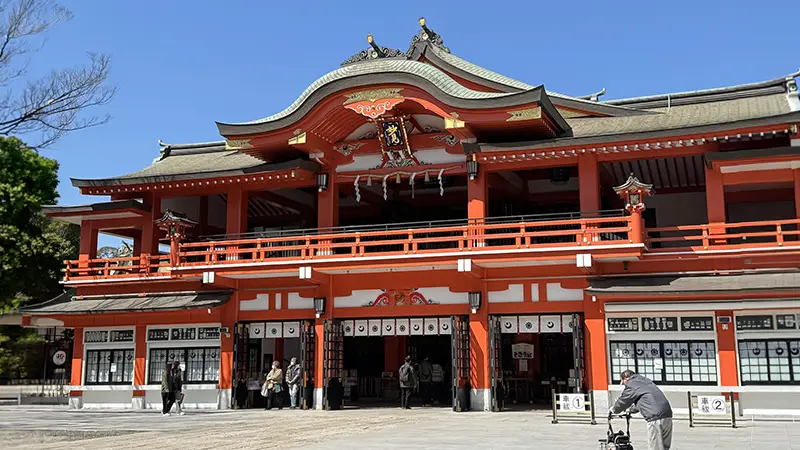
What met us was a blaze of vermilion. The main hall rises in two tiers — an unusual form for a Shinto shrine — and its lacquered pillars catch the light in a way that feels deliberately theatrical. The current building was constructed in 1990 to mark the shrine’s 990th anniversary.
I had read that the upper floor carries a stronger quality of sacred atmosphere, and that regular worshippers often climb to pray there. I climbed. The air was different.
From the second floor, looking out over the precinct, I could see the great gate directly ahead — and noticed that it too was not simply a gate. It contained a hall. Within that hall stood the Fukutokuden: an eight-sided structure with the twelve zodiac signs arranged across its faces, each corresponding to a direction, an element, and a region of the human body. The building draws together Shinto, Buddhist, Taoist, and onmyōdō traditions — the Japanese art of reading direction and cosmic order. It is, in the most literal sense, a building about orientation.
I stood in front of it for a long time, and prayed at each face.
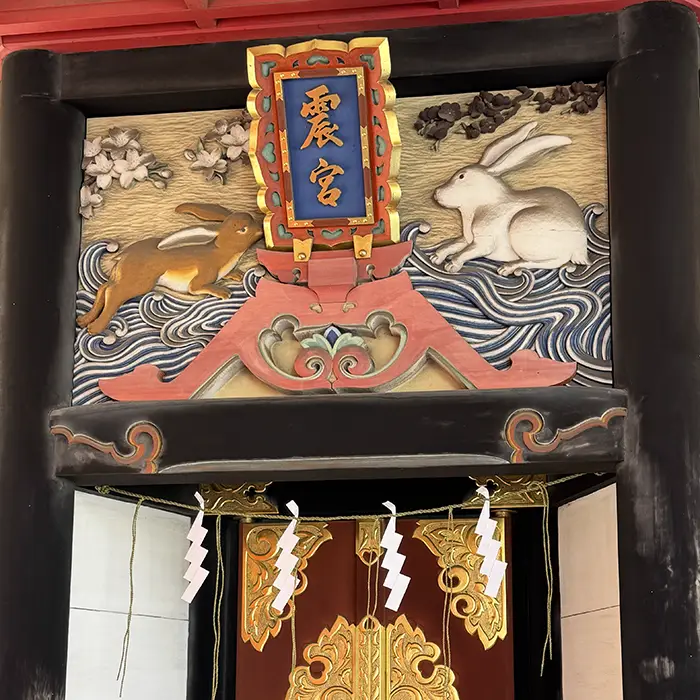
The Deity of the Northern Sky
Myōken Bosatsu — the deity enshrined at Chiba Shrine — is not easy to categorise.
The name is often translated as something like “the bodhisattva of wondrous sight.” The object of worship is the North Star: Hokushin, the pole star around which all other stars appear to rotate. Some scholars trace its distant origins to the star-worship traditions of Central Asia, which may have travelled east along the Silk Road before entering Japan through Buddhist and Taoist transmission.
The North Star and the constellation of the Big Dipper — Hokuto Shichisei, the seven stars of the northern ladle — were understood as the axis of heaven, the pivot around which the cosmos turns.
To venerate Myōken was to place yourself in relationship with that axis. To ask for orientation. To request that the stars look upon you with favour.
In a world where war, plague, and political upheaval seemed to confirm that the normal order had broken down, the reliability of the northern sky was not a small thing.
A Warrior and His Star
Before the samurai, there were the tsuwamono — fighting men of the eastern frontier. Among them, Taira no Masakado is said to have carried Myōken Bosatsu as his personal devotional object.
Masakado died in 940 CE. He had spent much of his life in the Kantō — a region the Kyoto aristocracy called Azuma Ebisu, the eastern barbarians. He bred and raised fine horses, built cavalry units, and came to understand the land in ways that no courtier ever would.
And he looked north.
The North Star does not move. Every other star circles it. Something about that stillness may have mattered to those who lived at the edge of the order.
Myōken was also understood as a military deity. The star at the tip of the Big Dipper’s handle was called Hagun-sei — the Army-Breaking Star. Warriors who kept that star at their backs, it was said, would prevail.
Whether Masakado consulted the stars before battle, we do not know. What we know is that he carried a small image of Myōken Bosatsu — and that, far from Kyoto, in the eastern frontier under the northern sky, that star was his point of orientation.
After Masakado: The Chiba Clan
In 940, Masakado was defeated. The warrior who had briefly declared himself New Emperor was killed, his head sent to Kyoto, his rebellion suppressed.
But his faith did not end with him.
Among the Taira clan relatives who survived was Taira no Yoshifumi — a figure who, unlike the uncles who fought against Masakado, appears to have maintained a comparatively close relationship with him. Yoshifumi’s descendants would eventually become the Chiba clan, who rose to become one of the most powerful warrior families in the Kantō region and emerged as the most important patrons of Myōken worship in eastern Japan.
They established Chiba Shrine. They made Myōken their clan deity. They used a family crest — the tsuki-boshi-mon, the moon-and-star crest — that encodes the celestial symbolism of Myōken worship in its design. The nine-circle crest (kuyo-mon) associated with Masakado himself reflects the same stars.
A faith that a lone warrior carried into battle in the tenth century became, over the following centuries, the spiritual inheritance of one of the most powerful clans in eastern Japan.
The Artist Who Named Himself After the Star
Six centuries after Masakado, a painter in Edo chose a new name.
He had been known by many names throughout his career. This time, he settled on Hokusai — a name associated with the North Star and his devotion to Myōken Bosatsu. His connection to the northern sky shaped the name he chose to carry into history.
He also painted Masakado. In his Manga sketchbooks, Hokusai drew the warrior who had carried the same star deity centuries before.
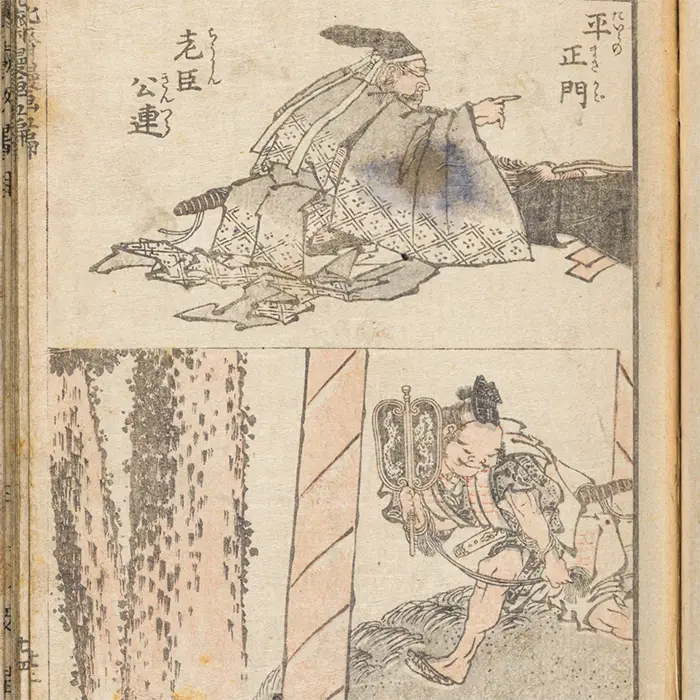
And a legend survives. Hokusai, it is said, fell into hardship at a certain point in his career and considered abandoning painting altogether. He prayed for twenty-one consecutive days at the Myōken Hall of Yanagishima(Hosshō-ji Temple) in Edo. On the final day, he was struck unconscious by lightning — and his fortunes changed. Whether taken as history or legend, the story reflects how closely Hokusai came to be associated with Myōken devotion.
The connection between a tenth-century fighter and an eighteenth-century painter is a name, a star, and a faith that passed from warrior to warrior house to struggling artist — and survived them all.
The Stars Are Still There
Myōken worship shaped the religious landscape of eastern Japan for over a thousand years. It shaped the name of Japan’s most famous artist. It shaped the crests of warrior clans. It shaped the two-storey hall and the eight-sided Fukutokuden of Chiba Shrine.
And it shaped something else — something still visible today, for those who know where to look.
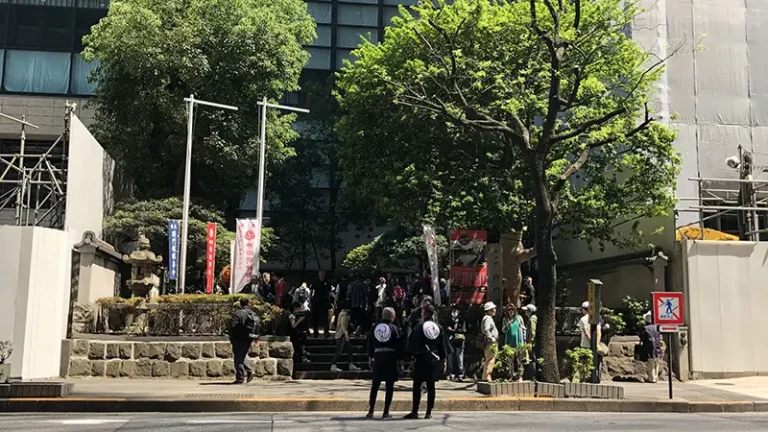
Seven shrines and sacred sites connected to Taira no Masakado are scattered across central Tokyo. When plotted on a map, an intriguing pattern begins to emerge. →(Masakado’s Mound)
(Some say the legendary monk Tenkai helped design this sacred geometry to protect Edo — though whether it was intentional or a cosmic coincidence is a story in itself. Read more about Tenkai and Edo’s Big Dipper legend here)
Why did warriors place such importance on the stars of the north?
To answer that, look up first — and then open a map.
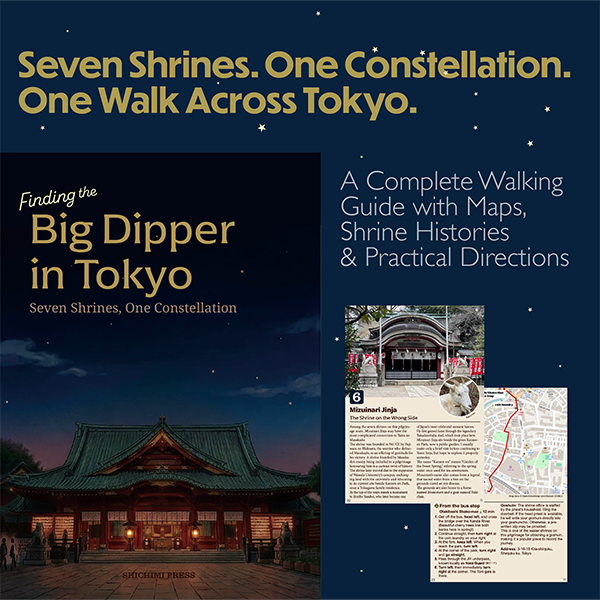
Want to walk the entire route yourself? The complete North Star pilgrimage, with maps and historical notes, is available in my PDF guidebook.