Japan’s Hidden Operating System: What Shrines Actually Do
If you have ever visited Japan, you have probably noticed how many convenience stores there are.
What you may not have noticed is that there is something even more common.
Japan has approximately 80,000 Shinto shrines.
There is an old Japanese saying: inu mo arukeba bou ni ataru — “even a dog, if it walks around, will run into a stick.” The meaning is roughly that you will encounter things — good or bad — simply by going about your life. I have always thought Japan needed a version that goes: “even a dog, if it walks around, will run into a shrine.”
I should confess something here. When my husband’s former boss was visiting Japan and asked for recommendations, I sat down and planned an entire itinerary. Every single stop was a shrine. My husband looked at the list and gently pointed out that his former boss was not, in fact, particularly interested in shrines.
This is a hazard of my way of seeing Japan. Everything connects to a shrine.
Related Article: How to Visit a Japanese Shrine: A Guide for First-Timers
Everywhere, Not Just Somewhere Special
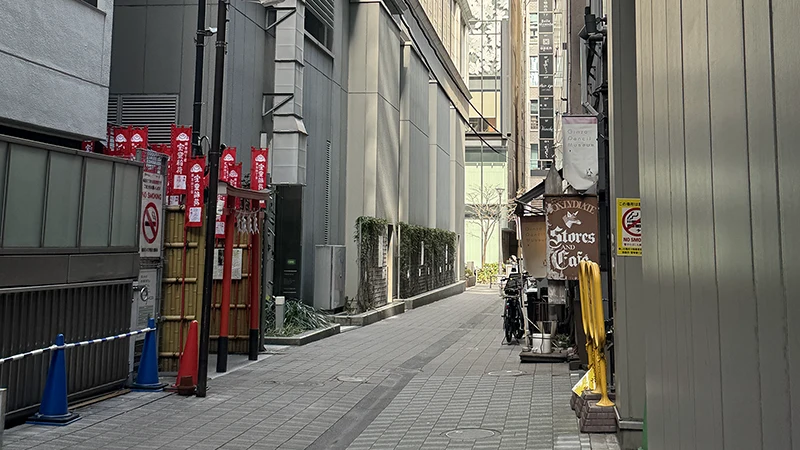
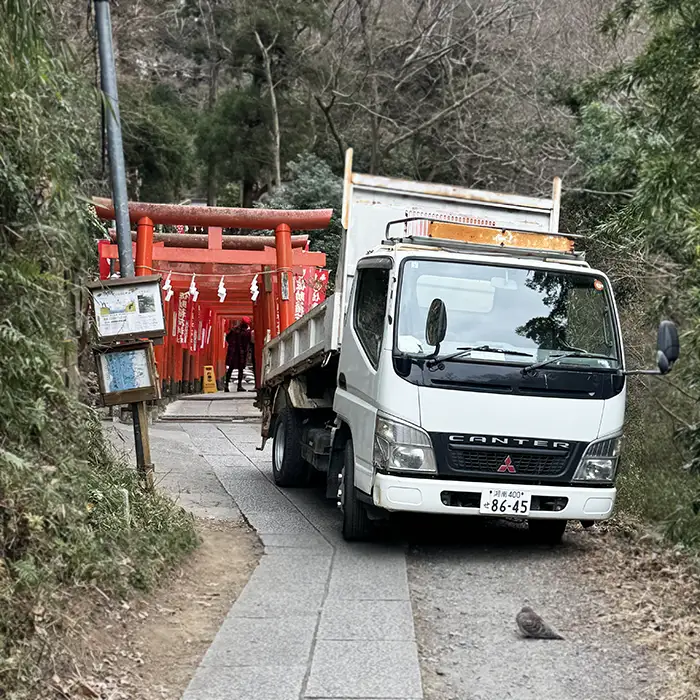
Shrines are not concentrated in famous cities or scenic regions. They are distributed across the entire Japanese archipelago — in dense urban centres, mountain villages, coastal towns, and wedged between apartment buildings and laundromats in residential neighbourhoods. Between the office towers of central Tokyo. Beside the train tracks in suburbs nobody visits.
A friend from Tochigi once wondered whether urban shrines — surrounded by concrete and commuters rather than ancient forests — might have a weaker spiritual presence. Her instinct was that something sacred belongs in expansive natural settings, not squeezed between a parking lot and a ramen shop.
This view shifts, gradually, when you start to see shrines not as isolated sanctuaries but as parts of a distributed system. A shrine in a Tokyo back street is not a smaller version of a shrine in the mountains. It is the same kind of thing, embedded in a different environment. Its presence is defined not by scale, but by density and proximity — by the fact that it is there, in the neighbourhood, in the ordinary flow of daily life.
A shrine is defined not by what surrounds it, but by what it does.
The Visible System
Walk into any shrine and you pass through several layers. Each layer is doing something.
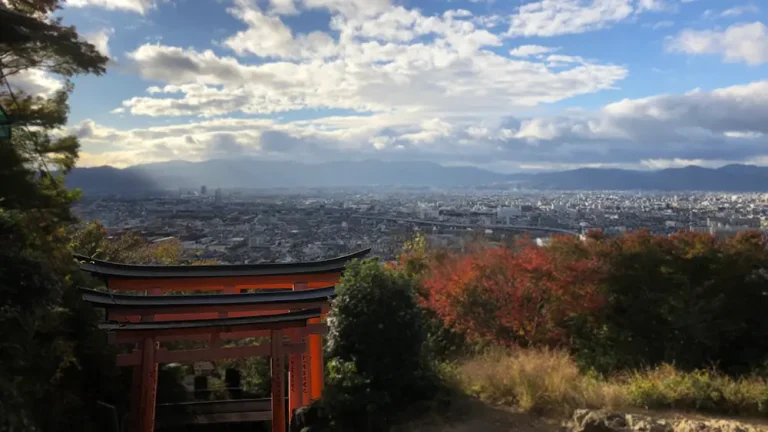
The first is the torii gate. Beautiful, certainly, but also functional. Passing through a torii is a state change — a transition from ordinary space into shin’iki (the sacred precinct).
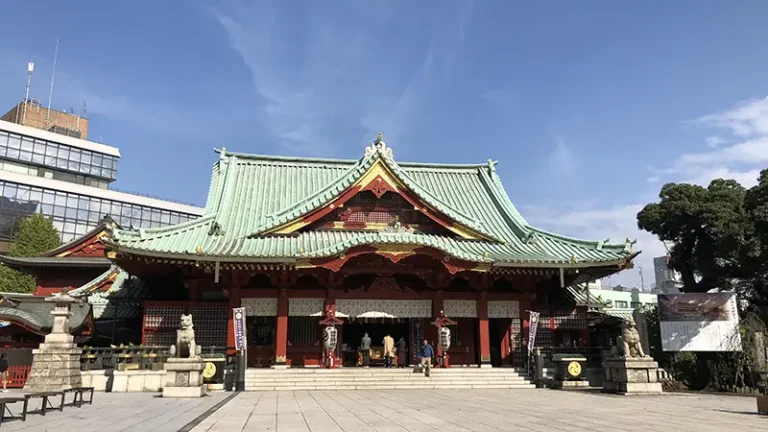
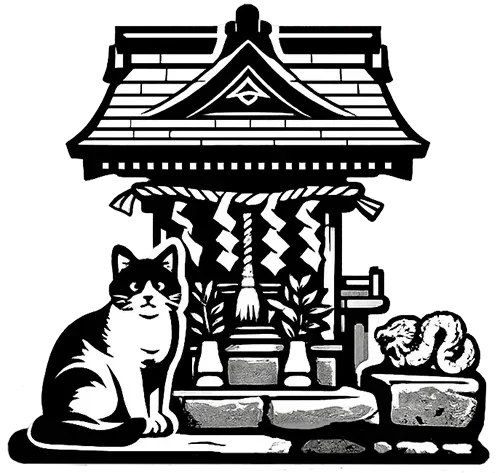
Further in, a pair of guardian figures called komainu flank the path or the main hall. They mark a further threshold — something stands here to hold the boundary between worlds. The form varies: some shrines have foxes, some have wolves, some have monkeys. The function is consistent.
Beyond that, the shrine divides into two main structures: the haiden (the hall of worship, where ceremonies take place and people offer their prayers) and the honden (the innermost sanctuary, where the enshrined deity actually resides, and which is generally not accessible to ordinary visitors). Sometimes these are separate buildings; sometimes they are integrated.
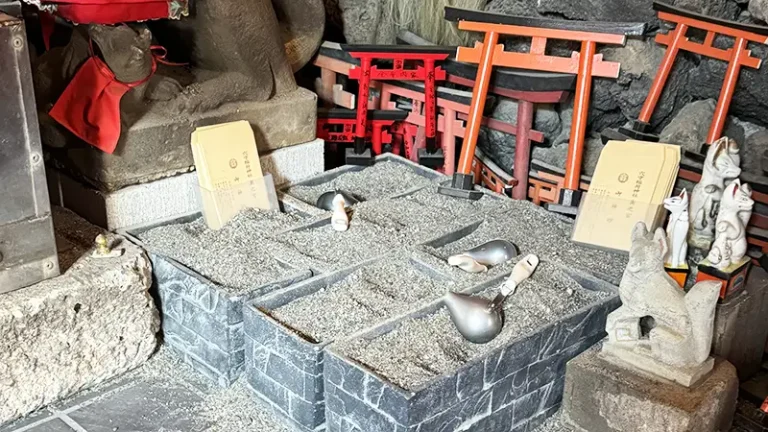
Many larger shrines also have smaller subsidiary shrines scattered across the grounds. The most common are Inari shrines, dedicated to Inari, a deity associated with foxes, agriculture, and business success. You will also frequently find tenjin shrines honouring the deity of scholarship. Sometimes these subsidiary shrines represent small neighbourhood shrines that were incorporated into a larger precinct as communities merged over time.
This is why a shrine is not a single point of meaning. It is a space of multiple relationships existing simultaneously.
The Invisible System
So far this has been mostly architecture. But the structure of a shrine extends beyond what you can see.
At the centre of every shrine is the enshrined deity. Everything else exists in relationship to that presence.
And around that centre, further layers extend outward.
One of those layers is purification.
Shrines are in a constant state of being cleaned. The chouzuya at the entrance — where visitors rinse their hands before approaching the main hall — is part of this. The Oharae, the Grand Purification ceremony held twice yearly in June and December, is part of it too: an opportunity for accumulated kegare — the weight of daily life: grief, worry, illness, and the ordinary burden of being alive — to be reset.
During Oharae, many shrines set up a large ring of woven grass called a chinowa. Passing through it in a specific pattern is a form of ceremonial cleansing. The Oharae is held twice a year: Nagoshi no Oharai (Summer Purification) in June, and Shiwasu no Oharai (Winter Purification) in December.
Kegare is often translated as “impurity,” but it does not carry the moral weight that word might suggest in English. It is less about wrongdoing and more about a kind of accumulation — the way a space or a person can become heavy with the residue of difficult things, and benefit from being cleared.
The water at the entrance, the purification salt at the amulet counter, the sand from shrines that someone once scattered on their carpet before they fully understood its purpose — all of it belongs to the same system. Different methods for the same essential reset.
What Shrines Actually Do
Put all of this together, and a shrine is not simply a building.
It is one of approximately 80,000 points of contact distributed across Japan — between the human world and the world of the kami.
They are not concentrated in places of particular natural beauty, or in areas of historical significance, because they are not primarily there to be visited. They are there to be present — in the neighbourhood, in the flow of daily life, available when needed.
A shrine marks the boundary between the ordinary and the sacred, and maintains it through ritual, through cleaning, through ceremony, and through the steady presence of the priests and workers who treat the act of sweeping the grounds as a form of worship in itself.
It provides a place to arrive with something — a prayer, a gratitude, a worry — and to leave it there — in the care of the shrine.
It holds the accumulated attention of everyone who has ever stood there, going back in some cases for more than a thousand years.
And it maintains a relationship between the people of a place and the kami associated with that place, across seasons and generations, through the ordinary rhythm of festivals and ceremonies and daily offerings.
Why They Feel Alive
You may have noticed, walking through a torii gate, that something shifts. The sounds of the street seem slightly farther away. Something in the body adjusts.
Some of this can be explained by trees, architecture, and the psychological effect of entering a clearly defined space. And all of those explanations are likely true.
But shrines are also places where people have been praying, maintaining, and paying attention for centuries. Sometimes for more than a millennium. That accumulation — of intention, of care, of habitual reverence — is not nothing.
Whether you call it the presence of a deity or the weight of history, the experience is real enough that most people notice it. And most people, regardless of background, find that they move a little differently inside.
My friend from Tochigi, who once questioned whether Tokyo’s urban shrines could really carry the same quality as her home region’s forested sanctuaries, now visits them every time she comes to the city.