I Vacuumed Sacred Sand: 3 Shinto Purification Secrets
Every time I consider the rituals of Shinto purification, I find myself drawn to the simplest elements — salt, water, and boundaries between ordinary and sacred.
At shrine receiving counters, I often find myself reaching for the salt.
I can’t fully explain why. There’s already salt in my kitchen — ordinary salt, bought from a supermarket. But shrine salt feels different. When I spot it among the other offerings, something in me lights up. “Oh. Salt! ” I take it, even though I’m not entirely sure I could explain to someone outside Japan why it matters.
Shrine salt is usually offered in two forms: edible (which can be used in cooking or for gargling) and ritual (meant only for purification purposes). People use it in different ways — placing it near the entrance of their home, carrying a small amount when going out, dissolving it in a bath, scattering it in a room after something difficult has happened.
This year, after badly burning the inside of my mouth, I dissolved some shrine salt in water and used it to gargle. Whether it helped in any technical sense, I honestly don’t know. It felt like it did something.
Before I go further: the small mounds of white salt you often see outside restaurants in Japan — morishio — come from a related but separate tradition, which I will cover at the end of this article.
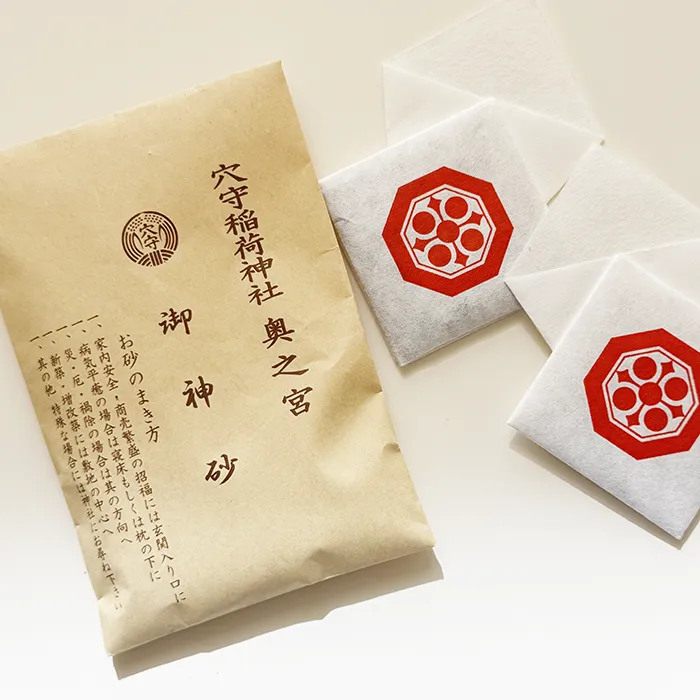
Goshinzuna (sacred sand) from Anamori Inari Shrine and Samukawa JinjaSalt and Shinto
Salt has been considered sacred in Japan for a long time.
In ancient Japan, salt was precious. It came from the sea — and in Shinto, the sea is a place of purification. After the god Izanagi returned from the underworld, he cleansed himself in seawater, and from that act of purification, some of the most important deities in the pantheon were born. The connection between salt, water, and purification runs deep into the mythology.
Salt also has practical properties that overlap with the concept of purification — it preserves, it cleanses, it prevents decay. Whether those practical properties are the reason for its ritual significance, or whether the significance came first and the properties confirmed it, I don’t know. Either way, the symbolic meaning is clear: in Shinto terms, salt disperses kegare (穢れ) — impurity, or the accumulated weight of negative experience — and helps restore a clear state.
This is why priests have traditionally used salt in purification ceremonies. It’s why a pinch of salt is placed on the lid of a coffin. It’s why sumo wrestlers scatter salt across the ring before a match. And it’s why small mounds appear at traditional entrances. All variations of the same idea.
Shrine salt has been offered before the deity and passed through Shinto ritual before it reaches you. The difference between that salt and the one in your kitchen isn’t chemical. It’s what happened to it before it got to you.
How people use it
This varies by shrine and by person.
Common uses include: placing a small amount near the entrance of a home or shop, on both sides — marking a boundary, discouraging impurity from crossing it. Dissolving it in a bath for a purifying soak, or using it to gargle after illness, grief, or a visit somewhere associated with death. Carrying a small amount wrapped in paper as a kind of portable protection — this is called mochishio, carried salt.
A small note on funerals: in Japan, the package given to guests after a funeral often includes a small sachet of salt. The custom is to use it at your own doorstep before entering your home — a brief moment of purification before crossing back into ordinary life.
My personal approach is simpler: I collect shrine salt. My drawer contains packets from multiple shrines, accumulated over years. When I use some, I think about which shrine to draw from. It’s a small ritual, but it connects me — even from the other side of the world — to specific places and the moments I received each one.
Sacred sand
Some shrines also offer kiyome suna — purification sand, also called o-suna (御砂)or goshinzuna (御神砂)— though it’s considerably rarer than salt.
When I want sacred sand, I go to Anamori Inari Shrine(穴守稲荷神社) in Tokyo, near Haneda Airport.
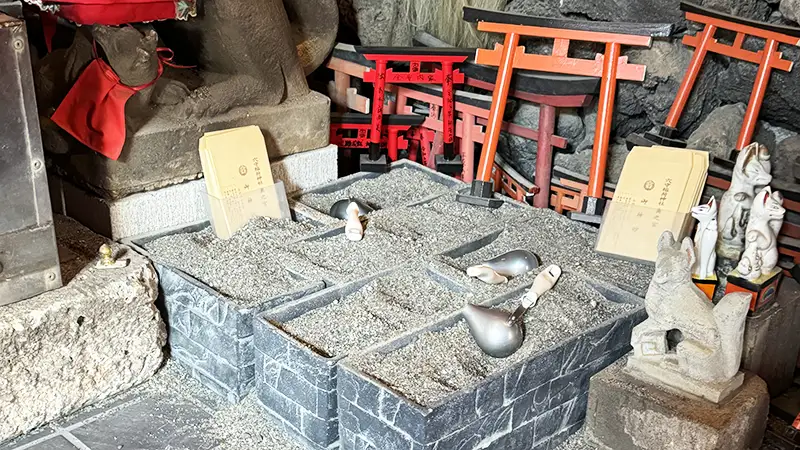
Tucked beside the inner shrine, there is a small cave-like space called the goshinketsu (御神穴)— the sacred cavity. Inside is a container of sand and a small shovel.
The first time I encountered it, my immediate thought was: why is there a children’s sandbox here? Then I read the sign.
Visitors are invited to pray first, make an offering, then use the shovel to scoop sand into one of the provided envelopes and take it home. There is something genuinely satisfying about doing this — reaching into a sacred space and retrieving something yourself, with your own hands.
The sand is there for those who come with genuine intent.
Inari’s messengers are said to notice such things.
The envelope explains the sand’s origins and uses. This area was once close to the sea, and the sand was believed to protect fishermen and bring good catches. The tradition of sharing it with those who need it has continued since.
This may sound strange to someone who didn’t grow up with it: a cave. a shovel. an envelope of sand.
The envelope lists its uses: for the sick, scatter it under the pillow; for protection, place it at the corners of a room.
I tried my own approach. I had recently moved, and the apartment still carried traces of its previous inhabitants — I couldn’t name what exactly, but I wanted a fresh start. So I scattered the sand across the floor.
Then I vacuumed it up.
It occurred to me almost immediately that shrine traditions probably did not envision this particular use of sacred sand.
I later looked up more careful instructions. At Ōmiwa Shrine in Nara, the sand comes from the sacred mountain itself. Recipients are advised to place it at the four corners of a room, starting from the northeast and moving clockwise. For apartment dwellers who can’t scatter it on the floor, a small dish near the entrance is suggested.
I had skipped all of that and gone straight to the vacuum.
Looking back, my fixation on vacuuming might stem from a deeper Japanese philosophy of space and cleanliness, which I wrote about in my article: Why Japanese People Clean So Much (And Why It’s Not Really About Cleaning)
On Morishio
The small mounds of salt found outside restaurants, shops, and traditional businesses are related to shrine salt, but they belong to a somewhat different tradition.
Their origins are surprisingly difficult to pin down.
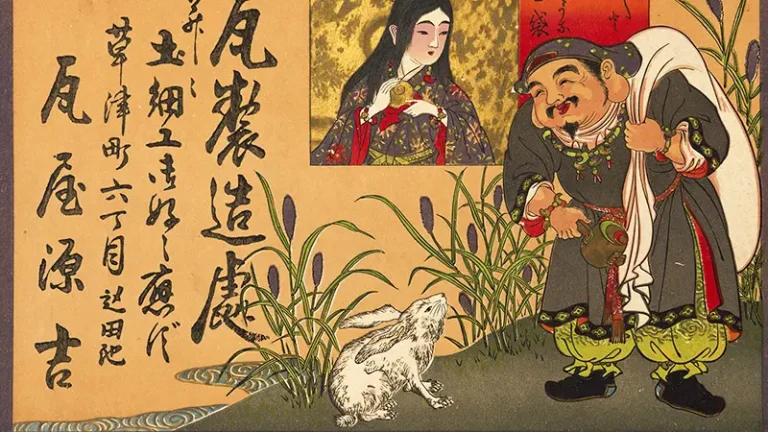
One popular explanation traces morishio to an old Chinese story. According to the tale, an emperor travelled between the residences of his consorts in a ram-drawn carriage. Hoping to attract the animals and encourage the emperor to stop at their doors, clever women placed salt-soaked bamboo leaves outside their residences.
Whether this story is the true origin of morishio is less certain.
Japan already had a long history of using salt for purification, and references to salt-based ritual practices appear long before later explanations of morishio became widespread. Some historians see the Chinese story as the origin of the custom. Others suggest it may have been attached to practices that already existed in Japan.
In other words, the history is a little murky.
What is clearer is how morishio is understood today. Small piles of salt are commonly associated with welcoming customers, inviting good fortune, and preventing impurity from crossing a threshold.
The details may vary, but the underlying logic feels familiar.
Like shrine salt, morishio creates a kind of boundary. Sometimes it is meant to keep something out. Sometimes it is meant to invite something in.
Either way, it marks the space as different from what lies beyond it.