Why Japanese People Clean So Much (And Why It’s Not Really About Cleaning)
When I moved to the United States after getting married, my first apartment opened directly into the living room. This sounds like a minor thing. It was not. Looking back, it was the first time I began to understand something important about Japanese ideas of cleanliness and space.
In Japan, every home has a genkan — a small recessed space between the front door and the living area, where you remove your shoes before stepping into the living space. The genkan is not decorative. It is a boundary. Outside ends there. Inside begins on the other side.
My American apartment opened directly onto carpet. The front door and the living room were continuous. There was no threshold, no pause, no place to set the outside world down.
I could not bring myself to wear shoes inside. So I took them off at the door — standing on the same carpet where I would eventually sit, eat, and sleep — which made the carpet itself feel perpetually contaminated. The outside world had no stopping point. It just… came in.
I started vacuuming constantly.
My husband mentioned to his sister, with what sounded like genuine admiration, that I kept the apartment so clean.
I was not a particularly exceptional cleaner. I was just someone trying to establish a boundary that the apartment’s design had declined to provide.
What felt uncomfortable was not only the dirt — though the dirt was real; you never know whose shoes have been where. It was the continuity.
Not just Hygiene: The Roots of Japanese Cleaning Philosophy
In Japan, cleaning is not just about visible dirt. It is also about maintaining a certain condition of a space.
The morning sweep of the front step. The daily wiping of the kitchen counter. The particular attention paid to the toilet. These are not responses to obvious mess. They are habits of maintenance — small acts of keeping things in the state they are supposed to be in.
The phrase that captures this in the context of Shinto is kiyome — purification, or cleansing. Not washing for the sake of washing, but restoring something to a state of clarity.
A shrine priest at Kanda Myojin, in a book about purification practices, describes the day of a shrine worker as “beginning with cleaning and ending with cleaning.” Not because the shrine is dirty, but because the act of sweeping the grounds is understood as tending to the space itself. The priest who sweeps does not just clean the path. They clear it — in the sense that a musician tunes an instrument, not because it is broken, but because it needs to be right.
Where the Outside Stops
The Japanese genkan is not an accident of architecture. It is a philosophy made physical.
It is simply a different way of structuring indoor space.
The outside world carries things: dirt, noise, the weight of other places, the residue of everything that happened before you came home. The genkan is where you set all of that down. You step out of your shoes and step into a different state.
Children learn this early. It becomes automatic. And when it is absent — as it was in my American apartment — the absence is felt as a kind of low-level discomfort that is difficult to name.
The same logic appears in other places in Japanese life, once you start looking for it.
Before entering a shrine, you rinse your hands at the chouzuya (temizuya). Not because your hands are visibly dirty, but because you are crossing into a different kind of space. The rinsing is the signal — the moment the transition is marked. Before a meal, itadakimasu does the same thing in a smaller way: a pause, an acknowledgment, a shift from ordinary time into the act of receiving. And the small pile of salt at the entrance of many shops and homes? Not seasoning. A boundary marker. A way of keeping certain kinds of things out.
Sacred Salt and Cleansing Sand
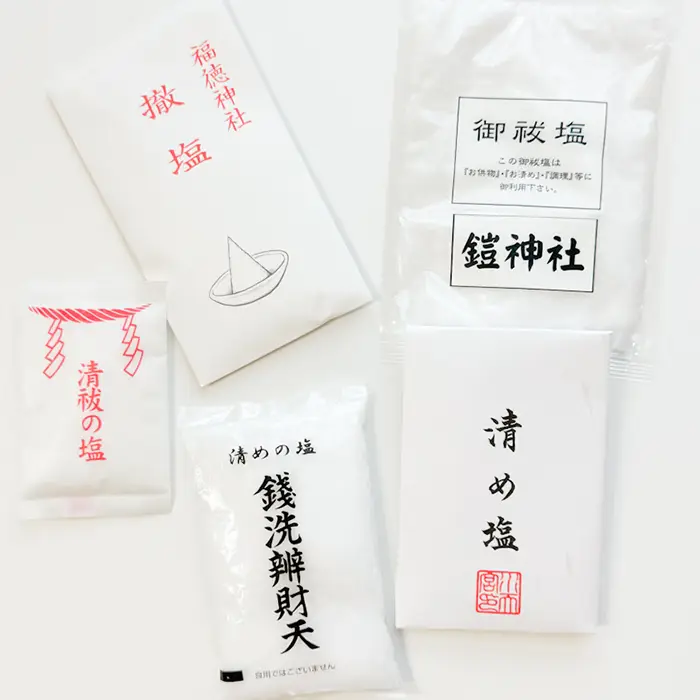
At many shrines and some temples, among the items available at the amulet counter, you will find kiyome-jio (purification salt) and kiyome-suna (purification sand).
To someone outside Japan, these are probably just salt and sand. I understand that reaction. But these are not the same as cooking salt or garden sand — they have been offered before the enshrined deity and blessed through Shinto ritual. The difference is in what was done with them before they reached you.
The uses vary. Purification salt is placed near the entrance of a home or business, sprinkled in a room after a difficult event, dissolved into a bath, or carried as a form of protective charm. Purification sand is used to mark boundaries — at the threshold of a space, at the corners of a room, at places where something needs to be defined or separated.
When I return to Japan, I almost always bring some home. The small packet sits on a shelf until I find a use for it. Sometimes it is for a specific reason. Sometimes it is just the sense that I would like to have it nearby — something brought from a specific place, offered before a specific kami, to be used when the need arises.
This year, after burning my mouth badly, I dissolved some in water and used it as a gargle. Salt water is often recommended for minor mouth injuries, and it did seem to ease the discomfort somewhat.
If you see these at a shrine and find yourself wondering what they are, the short answer is: portable kiyome. A way to carry the act of purification with you, and apply it where your own threshold needs establishing.
(By the way, if you want to know what happens when you actually try using this sacred sand at home—and how I ended up vacuuming it—check out my hands-on experience here: I Vacuumed Sacred Sand: 3 Shinto Purification Secrets
)
The Mythological Root
To really understand where this comes from, you have to go back to the Kojiki, Japan’s oldest chronicle, compiled in 712, which I find myself returning to often.
There is a story about Izanagi, one of the creator deities. He descended into the underworld to find his wife Izanami, who had died. What he found there was not what he hoped. He fled. And when he emerged, he bathed in a river to cleanse himself of the pollution of the dead realm.
As he washed, deities were born from him — including, as he rinsed his left eye, Amaterasu the sun goddess.
This is the origin story of purification in Shinto. The act of cleansing was not simply hygienic. It was generative. Something new became possible because something accumulated had been washed away.
Every time I watch someone rinse their hands at the chouzuya before entering a shrine, this story comes to mind. The act is the same one, scaled down for daily life: wash off what has accumulated, and make space for something new.
The word misogi — the ritual bath — derives, by one account, from mi wo sosogu (“to rinse the body”). The hand-washing at the chouzuya (temizuya) before shrine worship is understood as a simplified form of this same ancient act.
Purification in Shinto was never just about hygiene. It was always about what becomes possible after.
The Rhythm of Reset
Purification is not a one-time event. It is a rhythm.
Daily: the morning sweep, the wiped counter, the shoes left at the door. My mother, back in Japan, wakes up every morning and cleans the genkan and the toilet first thing — the boundary between outside and inside, and the place of release. That has always been her first act of the day.
Twice yearly: Oharae, the Grand Purification ceremony held at shrines across Japan each June and December. People recite the words of a purification prayer and pass through symbolic forms of cleansing — sometimes with a paper doll that absorbs accumulated misfortune before being cast into water.
Annually: the end-of-year oosoji, the great cleaning. Not just tidying, but a thorough clearing of the space before the new year begins.
Each of these operates on the same principle: things accumulate. Not just dust, but states. Heaviness. Residue. The weight of time that has passed without being processed.
The cleaning is not to restore a surface to visual cleanliness. It is to restore the whole space — and the people who inhabit it — to a condition from which the next period can begin properly.
What This Looks Like From Outside
To someone who did not grow up with this, it can look like excessive cleanliness. Or superstition. Or an odd fixation on salt.
I say this as someone who now lives in the United States, and who has occasionally caught myself wondering how these habits appear to the people around me.
The objects are ordinary enough. Salt. A broom. Water.
But the acts have meaning, and they connect to each other. The genkan connects to the chouzuya, the chouzuya to the oharae, the oharae to the year-end cleaning, the year-end cleaning to the purification salt on the shelf.
Each is a version of the same question: what has accumulated here, and how do I return to a clear state?
The Japanese answer to this question is practical, daily, and ongoing.
It just happens to look, from the outside, like someone who vacuums rather frequently.