The Rabbit That Meant Something Different in Japan
On moons, battlefields, shrines, and why I keep collecting rabbits
THE RABBIT PROBLEM
I collect rabbit things. Over the years, I have come to understand that Japanese rabbit symbolism is far richer than I ever imagined.
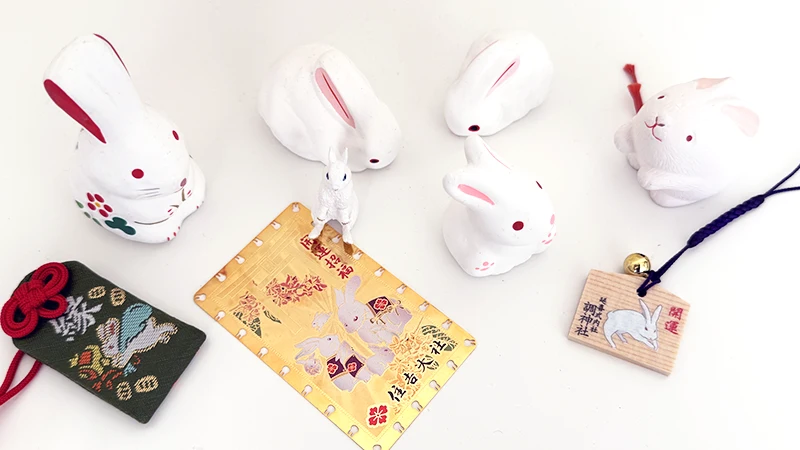
Shrine charms, ceramics, textiles, small objects with no practical purpose whatsoever — anything marked by the presence of a rabbit.
Living in the United States, this turns out to be a surprisingly difficult hobby to maintain. Rabbits appear in shops reliably in March and April, when Easter approaches, and then largely vanish until the following spring. During those weeks, they are everywhere: in supermarkets and craft shops, on chocolates, on greeting cards, in pastel colours, often holding eggs or surrounded by flowers. Soft. Seasonal. Mostly decorative, or aimed squarely at children.
Then the holiday passes, and they disappear.
I grew up in Japan, where rabbits do not disappear.
They appear on shrine grounds and in autumn festival decorations, on the crests of samurai families, and in centuries-old illustrated scrolls. They live on the moon. They are woven into one of the oldest and most quietly devastating stories in Buddhist tradition.
The Easter Bunny is charming, with its pastel colours, and I am genuinely fond of it. But it is not quite the rabbit I grew up with.
THE RABBIT WITH PERSONALITY
Rabbits have appeared in Japanese art for a very long time — in decorative patterns, in Buddhist imagery, in traditional textiles and various other places. But for most of that history, the rabbit was a symbol. A motif. Something to be depicted rather than given a personality.
That changed, as best as anyone can tell, sometime in the twelfth or thirteenth century.
The Chōjūgiga — usually translated as the Scrolls of Frolicking Animals — were painted most likely by monks at Kōzanji temple in Kyoto. They are considered among the earliest examples of narrative illustration in Japan. Art historians have spent considerable time debating their meaning and authorship.
The rabbits in them are wrestling frogs.
Not reverently. Not decoratively. They are mid-match, limbs tangled, clearly competing, with the particular focus of animals who intend to win. Elsewhere in the scrolls, rabbits shoot arrows, perform rituals, and generally conduct themselves with the confident irreverence of creatures who know exactly what they are doing.
There is nothing soft about them. Nothing pastel. These are rabbits with personality — mischievous, physical, fully present in the scene. For most of the long history before this, a rabbit had rarely if ever been depicted as an individual with a character of its own.
And characters, once they exist, tend to accumulate meaning.
THE RABBIT ON THE BATTLEFIELD
In the collection of the Metropolitan Museum of Art in New York, there is a sixteenth-century Japanese helmet shaped like a crouching rabbit.
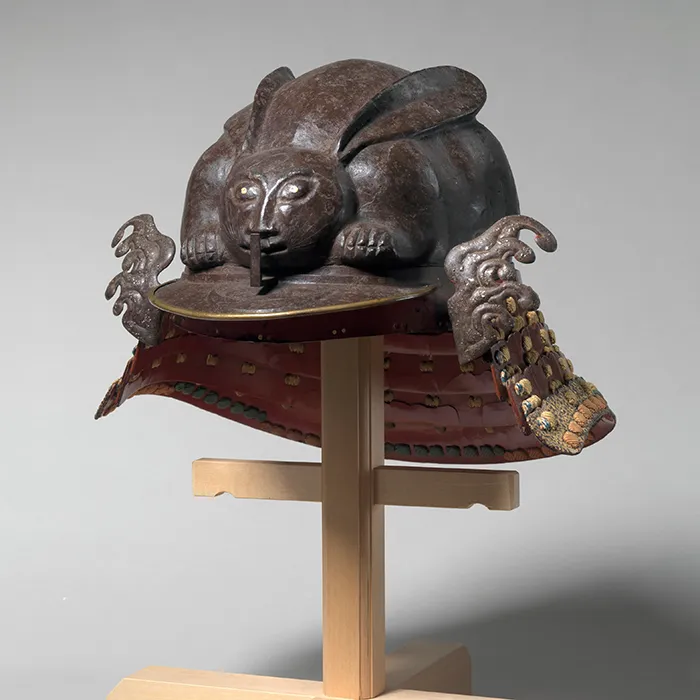
in the Met Collection
When I first saw it, I stopped in my tracks — a genuine double-take moment. A rabbit on a samurai helmet? I stood there grinning, and found myself going back to look at it more than once. I kept picturing some fierce warrior charging into battle with a rabbit on his head, and couldn’t help smiling.
Later, I learned that this is a kawari-kabuto — a style of highly individualised helmet that emerged during Japan’s Sengoku period, the era of warring states, when the country was caught in decades of near-constant military conflict. As armies grew larger, individual warriors needed to be identifiable on the battlefield. Higher-ranking samurai began commissioning helmets of striking, personal design: animals, waves, demons, mythological figures. A warrior’s helmet was a declaration of who he was. It needed to be read at a distance, under pressure, in the chaos of battle.
Choosing a rabbit was not choosing softness.
In Japanese symbolism, the rabbit is admired not for standing and fighting, but for moving relentlessly forward through speed and powerful leaps. It does not turn back. The Japanese word chōyaku — a great leap forward — carries the energy of something unstoppable. A rabbit on a helmet announced momentum, agility, the refusal to be stopped.
But this particular helmet carries something more. The ear guards are shaped as waves. And a samurai who knew his classical literature would have recognised the combination immediately — it is a reference to the Noh play Chikubushima, in which a courtier travelling to Lake Biwa recites these lines:
“The moon dives beneath the lake, and the rabbit of the moon sports upon the waves.”
The warrior wearing this helmet was not simply announcing speed. He was announcing that he understood the moon, the water, the rabbit, and the poetry that bound them together. In the middle of a battlefield, he was making a claim about his own educated mind.
Knowing all of this, I thought back to standing in front of that helmet, grinning. It turned out the joke was on me.
By the sixteenth century, the rabbit had become a code. One that only the educated could fully read.
THE RABBIT ON THE MOON
Look at the full moon on a clear night in Japan, and someone will eventually say: there it is. The rabbit.
This is not metaphor. It is simply what people see. Where other cultures find a face, a bear, a man with a bundle of sticks, Japanese tradition sees a rabbit standing before a mortar, pounding something with a small wooden mallet.
That last detail — the mallet, the pounding — turns out to have its own history.
The image of a rabbit on the moon came to Japan from China, where it had existed for centuries. In the original Chinese tradition, the rabbit was making medicine — an elixir of immortality, to be precise. The image arrived in Japan through classical texts and illustrated encyclopedias, spreading gradually from scholars to a wider reading public as Edo-period publishing transformed who had access to books.
Somewhere in that process, the immortality medicine became, in Japan, something far closer to ritual food: mochi — rice cakes, a sacred offering deeply embedded in Japanese ritual life.
Scholars studying Edo-period illustrations have traced the shift: the shape of the mortar in the drawings changes, from a straight-sided Chinese form to the distinctly waisted shape used in Japanese kitchens. The text never explained what the rabbit was making. But for ordinary readers, a mallet and a mortar meant one thing — and it was not immortality medicine.
The rabbit on the moon is not a fixed image. It is a translation that changed shape as it crossed languages, books, and daily life. But the rabbit’s journey through Japanese imagination did not begin in the sky. Long before it became the creature we see on the moon, it appeared in one of Japan’s oldest stories — a tale of deception, suffering, and unexpected kindness on a distant shore. I explored that story in The Rabbit Before the Moon.
What did not change was the rabbit’s presence there. Japan simply gave it work that felt like its own.
THE FIRE
But why is the rabbit on the moon at all?
The answer is in one of the oldest stories in Buddhist tradition.
A god — Indra, lord of heaven, known in Japan as Taishakuten — came down to earth in the form of a starving old man. He had come to test the compassion of the animals. One by one, a monkey, an otter, and a jackal went out to find him food, returning with what they could carry.
The rabbit had nothing to bring. It could not fish. It could not climb trees to gather fruit. It had only itself.
So the rabbit gathered wood. Built a fire. And jumped in.
Please eat me, it said. I have nothing else to give.
Indra — revealing his true form — reached into the flames and pulled the rabbit out unharmed. Moved beyond words, he took the rabbit’s image and pressed it into the face of the moon, so that all beings in all ages might see it and remember what the rabbit had done.
This is why the rabbit is there.
Not because of the shape of craters, or the play of light on ancient rock — though it is those things too. But because, in Buddhist tradition, the moon became the rabbit’s monument. A record of a sacrifice so complete that it had nothing left to offer except itself.
Since hearing this story, I have never quite been able to look at the moon the same way. The rabbit up there is not merely decorative. It had a reason to be there.
RABBITS AT THE SHRINE
If you spend enough time visiting shrines in Japan, you start to notice rabbits.
Not everywhere. But often enough that it stops feeling like coincidence.
At Okazaki Shrine in Kyoto, rabbits appear all around the grounds. The shrine sits to the east of the old imperial capital, the direction of the rabbit in the traditional compass, the direction from which the sun rises. Wild rabbits once lived in abundance on the grounds and in the surrounding fields. Their prolific nature made them natural symbols of fertility, and the shrine became associated with safe childbirth and the blessing of children. The rabbit here arrived from nature: from the actual animals that lived in the place itself, combined with the geometry of a city that had assigned the east to the rabbit before the shrine was even built.
In Uji, south of Kyoto, the connection runs differently. The city’s name was once written as 菟道 — a name containing the character for rabbit. Whether this originally referred to rabbits moving through the landscape, or whether the name came first and the rabbits followed in the imagination, is still debated. What is not debated is that the rabbit took root in the language of the place. At Uji Shrine, a small figure known as the mikaeri usagi — the rabbit who looks back — stands near the entrance, its head turned over its shoulder, said to guide visitors toward the right path and good fortune. Here the rabbit was not found in a field. It was found in a word.
In Kyoto, rabbits are not only animals. They are geography, language, and memory made visible.
At Tsuki Shrine in Saitama, the connection comes from the moon itself. The shrine is dedicated to Tsukuyomi no Mikoto, the lunar deity, and has long been associated with moon-waiting — the old practice of gathering on certain nights to pray as the moon rose. Rabbit figures replace the customary guardian dogs throughout the grounds, and rabbits appear on the purification fountain and across the shrine buildings. Here, the rabbit of the moon has become the sacred space itself.
Three shrines. Three different reasons for the rabbit.
Nature. Language. Moon.
What they share is not a single story, but a single quality: in Japan, the rabbit keeps arriving in sacred space by different routes, for different reasons, and stays.
THE EASTER BUNNY, RECONSIDERED
I actually like the Easter Bunny quite a lot.
It is cheerful, reliable, and arrives every spring without fail. Children love it. It brings chocolate. There is something genuinely lovely about a creature so thoroughly associated with new beginnings, with the lightness of a season that keeps returning.
But it is a creature of a single season. It comes, fills the shelves, and when the holiday passes, it goes. Its cycle is short by design — it belongs to a particular moment, and that moment is fleeting.
The rabbit in Japanese culture does not have a season. It is in the moon, which rises every night. It is in the zodiac, which governs the year of your birth and follows you for life. It is carved into shrine stone and buried in city names and painted on the helmets of long-dead warriors. It jumped into a fire once, and was placed in the sky for it.
This is not a criticism of Easter. It is simply a description of a different relationship — one in which the rabbit was never just decorative, never just for children, never just for spring.
STILL COLLECTING
My rabbit collection keeps expanding.
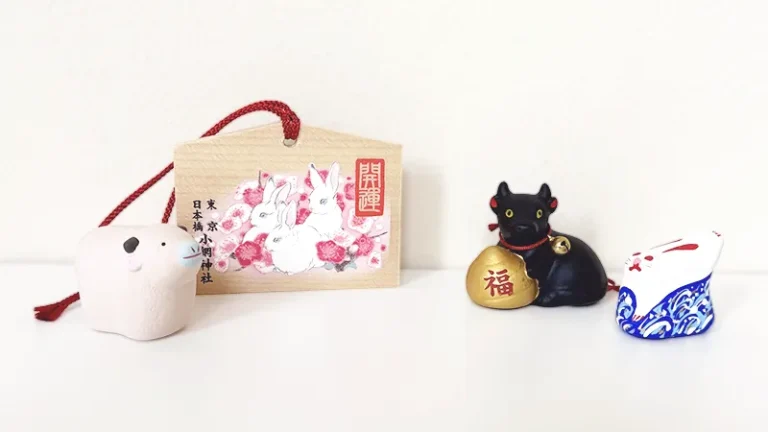
During the Year of the Rabbit in 2023, I researched which shrines would be offering rabbit-themed amulets and lucky charms, and visited as many as I could.
And of course, every Easter I still head straight for the shops, happily conducting my own Easter rabbit hunt. This year, I found a beautiful Easter tin decorated with rabbits, and was absurdly pleased with myself.
I suspect the shelves will continue to fill.
Then again, rabbits have always been symbols of abundance.