Nenjibutsu: Why Japan’s Warriors Carried Buddha into Battle
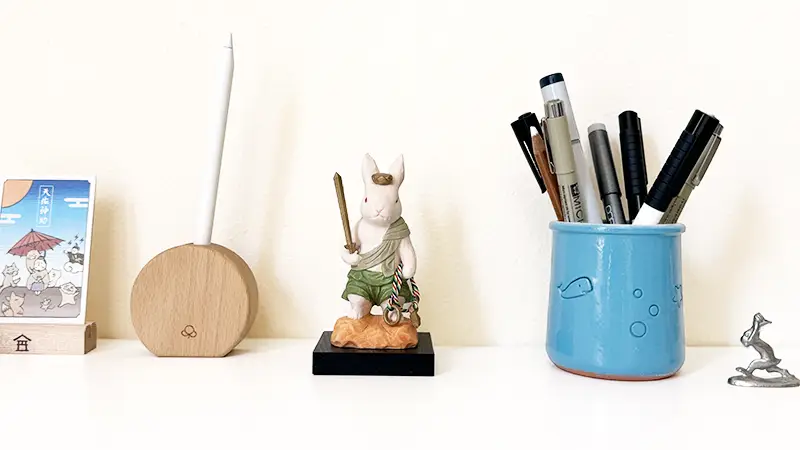
On my desk sits a small figure holding a sword.
It is a statue of Fudō Myōō — one of Buddhism’s most fierce-looking deities, typically depicted surrounded by flames, wielding a blade, his expression a deliberate and concentrated fury. The figure on my desk is about ten centimetres tall.
It is also a rabbit.
The statue was produced in the year of the rabbit and consecrated at a Fudō temple. I bought it immediately. I keep it on my desk. Whether it counts as a nenjibutsu (念持仏)— a personal devotional image, carried close to the body — is perhaps a question of degree. But the impulse behind it is not so different from what I am about to describe.
A World That Needed More Than Strategy
To understand why Japan’s warriors carried small statues into battle, it helps to understand what they believed the world was.
In the mid-eleventh century, according to a widely held medieval Japanese Buddhist belief, the world entered mappō — the age of the Dharma’s decline. Beginning from the year 1052, the belief held that no matter how many good deeds a person performed, salvation through one’s own efforts was no longer possible. The world was in decay. Only the compassion of the Buddha could save you.
This was not abstract theology. Disasters, epidemics, and wars seemed to confirm it. For warriors whose profession required killing — and who understood that each battle might be their last — the question of what happened after death was not philosophical. It was immediate.
Into this anxiety came the nenjibutsu: a small devotional image, held in the hand, tucked into the folds of armour, or tied into the topknot of hair.
The Buddha in the Hair
In the Kamakura period, a particular style of personal devotion became popular among warriors: the motodori Kannon, or topknot Kannon.
A tiny image of Kannon — the bodhisattva of compassion — would be bound into the bundle of hair at the crown of a warrior’s head. It stayed there through training, through travel, and through battle.
There are accounts of warriors whose lives were saved when a sword strike was deflected by this small figure woven into their hair. Whether taken literally or as the kind of story that gathers around a practice that means something, these accounts tell us what the nenjibutsu was for. Not decoration. Not superstition in a dismissive sense. A desperate, serious request: protect me. I am going somewhere I may not return from.
Choosing Your Buddha
Not every Buddhist deity was invoked for the same purpose.
Japanese Buddhism inherited a complex hierarchy of sacred figures, each with distinct qualities and areas of power. Understanding this helps explain why a warrior might carry several figures rather than one.
At the highest level sit the nyorai — the fully enlightened Buddhas, of whom Amida (Amitābha) is perhaps the most important for this story. Amida’s vow was to receive all who called on him into the Pure Land — paradise — after death. For warriors who knew they might kill and be killed, this was not a small thing.
Below them are the bosatsu — bodhisattvas, beings who have attained enlightenment but remain in the world to help others. Kannon is the most beloved, associated with compassion and protection.
Then come the myōō — wrathful manifestations of the Buddhas, of whom Fudō Myōō is the most famous. His terrifying appearance is deliberate: he guards against evil, burns away obstacles, and protects those in danger. He is, one might say, the protector called upon when force is required.
Finally, the tenbu — deities absorbed from Hinduism and other traditions, closer to human concerns, with specific areas of expertise. Bishamonten, the god of war and protection, is one. Daikokuten, associated with wealth and luck, is another.
Warriors understood this system practically. They chose their figures the way one assembles a team:
For salvation after death: Amida Nyorai. For protection in combat: Fudō Myōō. For victory in battle: Bishamonten. For practical success and fortune: Daikokuten.
One figure was rarely enough.
The historical record gives us many examples.
Four Warriors and the Shape of Faith
Taira no Masakado and the Star Deity
Among them, few figures loom larger than Taira no Masakado, who died in 940 CE and is still venerated in Tokyo today. The traditions surrounding him have endured for more than a thousand years.
Masakado is said to have carried Myōken Bosatsu as his personal devotional object — a bodhisattva associated with the North Star and the stars of the Big Dipper, a guardian of the north. In a region already treated as the periphery of the civilised world by the Kyoto aristocracy, Masakado’s devotion to a deity of the northern sky has a certain fittingness to it.
If you are interested, you can read more in this article: Masakado and Myōken: The Warrior Who Followed the North Star
That connection between Masakado and the stars would echo through later centuries. But that is a story for another article.
Uesugi Kenshin and the God of War
If any warrior in Japanese history could be said to have become his devotional object, it is Uesugi Kenshin.
Kenshin was born in 1530 and entered a Buddhist temple at the age of seven. His religious practice deepened throughout his life, across multiple sects and traditions. A document from 1570 records his daily devotional schedule in meticulous detail — which sutras were to be chanted, which mantras repeated, and how many times for each figure in his practice. He was, by the standards of any tradition, serious.
Bishamonten — the deity of war, depicted in full armour, standing on a demon — became the centre of his faith. Kenshin carried a Bishamonten image as his personal devotional object. He used the character 毘 (bi, from Bishamonten) as his battle standard. He came to believe — or others came to believe of him — that he was Bishamonten’s manifestation on earth.
In later life he shaved his head and took religious vows, receiving the highest ranks of Buddhist priesthood. He died in 1578.
The man who fought perhaps more battles than any commander of his era spent significant portions of his life in prayer.
Takeda Shingen and the Warrior’s Vow
Kenshin’s great rival, Takeda Shingen, carried a different faith into the same battles.
Shingen’s devotion centred on the deity of Suwa Grand Shrine — Suwa Myōjin, the kami of war and hunting whose sanctuary sat in the heart of Shingen’s home territory. When Shingen went to battle, he carried a banner inscribed with the deity’s name. The famous fūrinkazan banner — swift as wind, quiet as forest, fierce as fire, immovable as mountain — is well known. Less often mentioned is the other banner: Namu Suwa Nangū Hōshō Jōge Daimyōjin, the full honorific name of the Suwa deity.
Shingen also commissioned a statue of Fudō Myōō — the wrathful protective deity — modelled on his own face. The statue, now at Erinji Temple in Yamanashi Prefecture, was made in 1572, one year before his death. Whether it was intended as a devotional object for his own lifetime or as a way of leaving his protective presence behind for the Takeda clan after his death, the inscription inside the statue confirms its date and craftsmanship.
A warrior, in his final year, sitting for a portrait in the form of a wrathful Buddha.
Whether he saw it as an act of devotion, a statement of authority, or both, we cannot know.
It is difficult not to wonder whether this reflected deep devotion, extraordinary confidence, or perhaps a little of both.
Tokugawa Ieyasu and the Black Buddha
If Kenshin’s faith was devotion and Shingen’s was devotion combined with strategy, Tokugawa Ieyasu’s approach to the sacred was — characteristically — thorough.
Ieyasu carried two devotional objects to battle.
The first was an image of Marishiten — the deity of the sun’s rays, described as moving invisibly through the world, impossible to capture or harm. For a warrior who understood that surviving battle was partly a matter of not being seen at the right moment, Marishiten’s particular quality of invisibility had obvious appeal.
The second was the Kuro Honzon — the Black Honzon — an image of Amida Nyorai now housed at Zojoji Temple in Shiba, Tokyo, in the shadow of Tokyo Tower. The statue stands 78 centimetres tall and is lacquered entirely black, a colouration that accumulated through centuries of incense and lamp smoke from the prayers of the faithful.
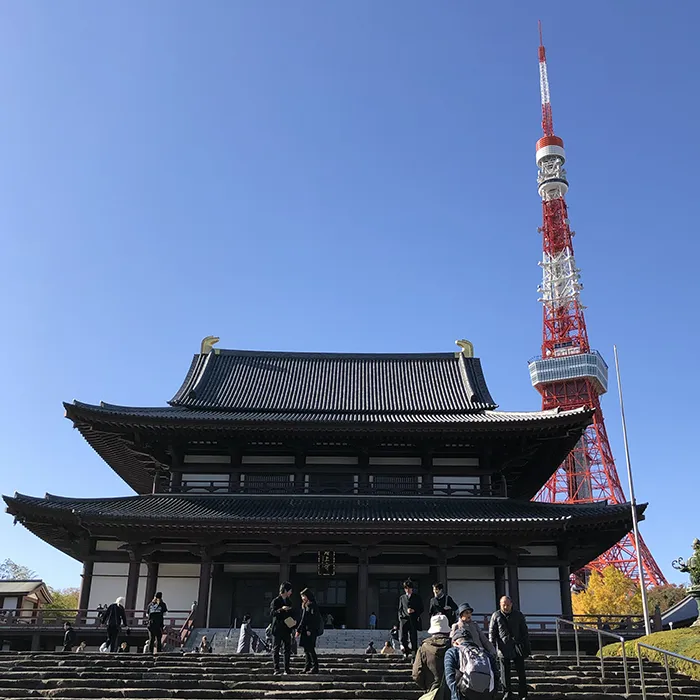
Ieyasu is said to have kept this image with him through his campaigns. When he faced crisis, he prayed before it. The statue acquired a reputation as a source of kachi-un (victorious fortune) and that reputation has persisted for four centuries.
Today, Zojoji Temple receives visitors from around the world. Most come to see the temple’s architecture and Tokyo Tower rising behind it. Few know that one of the most significant sacred objects in the building is a small, blackened image of Amida that a future shogun once carried into battle.
The Kuro Honzon is a secret Buddhist image — hibutsu — and is shown publicly only three times a year. But it is there, in the same temple where it has been for centuries, still receiving prayers.
Ieyasu, who lived to seventy-three and outlasted every rival of his generation, carried both Marishiten and Amida into his campaigns — the invisible deity of survival and the compassionate guide to paradise. Whatever came, he was prepared for it.
What the Nenjibutsu Was
Warriors are typically imagined as people of action — riding into battle, training, commanding. But reading through the historical record, what stays with you is often the opposite. They read sutras, chanted mantras, sat before the Buddha. Because there was no guarantee of returning from the next battle, they took the quiet time of prayer seriously.
A nenjibutsu was not a lucky charm in the casual sense. It was a relationship — a specific, ongoing commitment to a particular sacred figure, maintained through daily practice, prayer, and offerings.
It was also small enough to carry into battle. Small enough to tuck into a helmet. Small enough to bind into your hair.
The impulse behind it is not difficult to understand. You are going somewhere dangerous. You want something that has been held in the presence of the sacred to go with you. You want, in the most serious possible sense, to not be alone.
Japan’s warriors understood this with a clarity that comes from having no abstract relationship with mortality. They prayed with the same intensity they fought.
The Rabbit on My Desk
The figure of Fudō Myōō on my desk is about ten centimetres tall and shaped like a rabbit. It was consecrated at a temple. It was not made in the twelfth century.
But looking at this small figure that fits in the palm of my hand, I find myself thinking that warriors of centuries past must have felt something similar — entrusting themselves to figures just like this. The distance between them and me feels, in that moment, unexpectedly small.
Perhaps that is what a nenjibutsu was always meant to do.