How to Visit a Japanese Temple: It’s Not a Shrine (A Lesson I Learned Late)
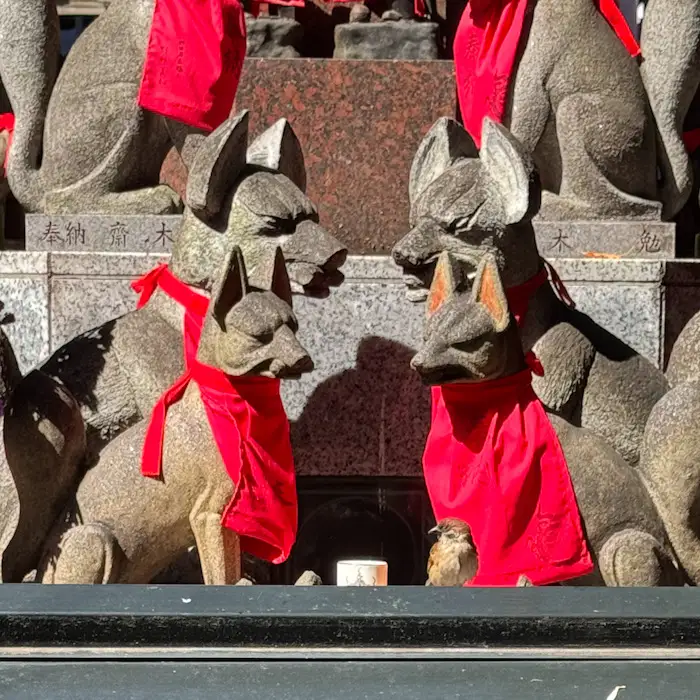
Many travelers wonder how to properly visit a japanese temple, but even as a Japanese person, the boundaries can feel a little blurry. When I was a child, my family used to visit a place in Akasaka, Tokyo for hatsumode — the first shrine visit of the New Year. It was always crowded and a little chaotic, with fox statues everywhere — kitsune, the messenger figures associated with Inari.
I clapped my hands to pray. It felt like the obvious thing to do.
For years, I did exactly that.
Then, as an adult, I visited the same place and realised with some surprise that it was a temple. Not a shrine. I mentioned this to my mother.
“Did you not know?” she said. As if I were the strange one.
This is actually more common in Japan than you might think. For much of Japanese history — up until the Meiji era — shrines and temples existed in a blended state called shinbutsu-shugo, where Shinto and Buddhism had intertwined so thoroughly that the distinctions were often unclear. Foxes at a temple? Perfectly normal. Clapping at a Buddhist altar? Easy mistake.
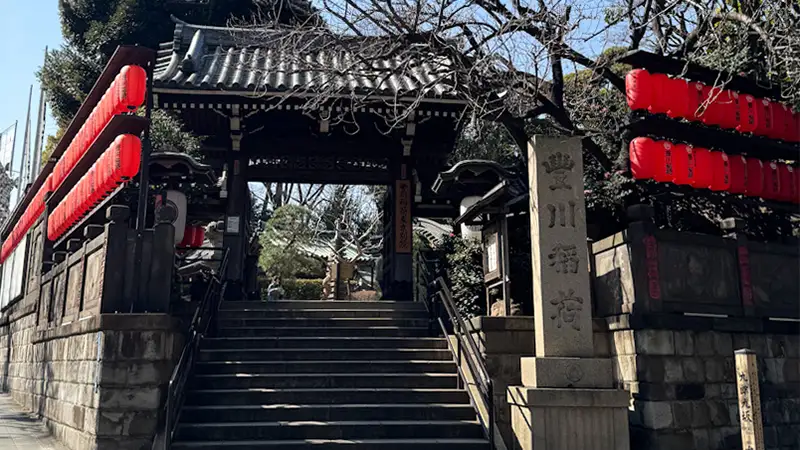
The place, by the way, was Toyokawa Inari Tokyo Betsuin — a Buddhist temple dedicated to Inari, a figure associated with foxes and prosperity in Japanese folk belief. The details are more complex than this suggests, but it sits comfortably within Japan’s long tradition of religious blending.
What to Know Before You Visit a Japanese Temple
A Shinto shrine enshrines kami — divine spirits. A Buddhist temple enshrines the Buddha and bodhisattvas. Same country, very different traditions.
One quick way to tell them apart: shrines have torii gates. Temples usually have a sanmon — a large ornate gate — and often a cemetery nearby.
Which brings up something worth knowing.
Temples in Japan have long been closely associated with death. Funerals, memorial services, ancestral rites — these have traditionally been the domain of Buddhist temples. Shrines are often associated with life events and beginnings — births, weddings, harvests, new year celebrations. Temples sit closer to the world of the departed.
This gives many temples a different quality of air. Quieter, perhaps. More still, rather than heavier. Not unwelcoming — just more settled.
At the Gate
Bow once when you pass through the main gate (sanmon). Same principle as a torii: you are entering a different kind of space.
Purification
Many temples do not have a chouzuya for hand-purifying. Some do — if there is one, use it as you would at a shrine.
Some practitioners use zukoh — a powdered incense rubbed on the palms — before entering. I do this myself. It is not widely expected of general visitors, but if you happen to encounter it and are curious, ask.
The Offering
Place your offering gently in the box. Same as a shrine — not a throw, not a toss.
If there is a waniguchi — the flat hanging bell — you may ring it gently before praying. Or not. It is optional.
The most important difference: no clapping.
At a Shinto shrine, you clap twice to call the kami. At a Buddhist temple, you bring your palms together in gassho — quietly, without sound. The stillness is intentional.
When in doubt, look for a torii. A torii means shrine — clap twice. A large ornate gate without one means temple — hands together, no sound.
The Incense Burner
Many large temples have a joukourou — a large standing incense burner — in front of the main hall. This is where visitors offer incense before praying.
If you would like to participate: pay the small fee, receive your incense, light it from the candle provided, and extinguish the flame by waving your hand gently — never blow it out, and never shake it. Place the incense upright in the sand.
Then comes the part I have been doing since childhood: waft the smoke towards yourself.
The belief is that the smoke purifies and heals. Bring it to your head for wisdom. Bring it to wherever you are ailing. My cousins and I used to crowd around the burner as children, each of us silently directing the smoke with great personal urgency.
Wisdom. Better eyesight. Better face.
I still direct a noticeable amount of smoke towards my face. Some habits are hard to break.
Temples and Buddhist Families
Most Japanese families belong to a particular Buddhist sect, passed down through generations. The sect determines the style of funerals, memorial services, and ancestral rites.
My family is Tendai — a sect founded in the Heian period. I attended a high school affiliated with Shingon Buddhism, a different sect entirely, so my own background is a little layered.
This is, again, quite normal in Japan. Most people don’t choose their Buddhist affiliation the way one might choose a faith. It tends to be inherited along with the family altar. That said, plenty of people visit temples outside their family’s sect — a favourite local temple, a place they discovered on their own, a tradition they picked up somewhere along the way. The inherited and the personal sit alongside each other, usually without much conflict. Visiting a temple of a different sect is rarely treated as a dramatic change of religious identity.
What Temples Feel Like, To Me
Shrines and temples are not interchangeable, but both have a place in a life.
For shrines, I come with things I want to say: introductions, gratitude, requests, the small and the significant. There’s a directness to it.
It made me realise that prayer in Japan is not always a posture of certainty. It can also be something much more personal and unfinished.
I once attended a temple connected to Mount Koya and heard the head priest pray — quietly, and with complete sincerity — to Dainichi Nyorai for a future marriage partner. Specific conditions included.
No irony. No self-consciousness. Just a prayer, offered the way any other prayer would be.
That moment has stayed with me. However It blurred a boundary I hadn’t realised I was carrying — between “believer” and “teacher,” between someone who explains the tradition and someone who still needs something from it.
Temples feel different. Quieter. More like sitting with something than speaking to it.
Who I Think Of
The Buddha I think of when I’m anxious is Fudo Myoo — fierce-looking, surrounded by flames, deeply protective. I carry his omamori when I’m going somewhere that feels heavy.
When I’m unwell, I find myself thinking of Yakushi Nyorai, the healing Buddha.
This deeply personal connection to individual Buddhist figures actually mirrors how ancient samurai carried their own private deities. If you’re curious about how warriors brought their faith into battle, you can read more here: The Buddha Inside the Helmet: How Japan’s Warriors Carried Their Faith into Battle
Not exactly faith, perhaps. More like familiarity. Like knowing there’s someone home.
In many ways, it is less about asking, and more about remembering.
I’m not a priest or a scholar. Just a Japanese person who spends far too much time in both shrines and temples — and who only recently confirmed that the place she’d been visiting since childhood was, in fact, a temple.
If you want to avoid making the same mistake I did and want to know exactly how they differ, you might also find my guide on How to Visit a Japanese Shrine: A Guide for First-Timers helpful.